Kunstausstellungen – auch die der Gegenwartskunst gewidmeten – zeigen Objekte, die bereits geschaffen worden sind, also Werke der Vergangenheit sind. Die Dimension der Absenz ist durchwegs ein
blinder Passagier der musealen Praxis. Und diese Form der Abwesenheit lässt sich auch nicht mithilfe rezeptionstheoretischer Modelle habhaft werden, die auf die (vermeintliche?) präsentische Erfahrung im Rahmen einer unmittelbaren Subjekt (Betrachtet)-Objekt (Kunstwerk)-Beziehung abstellen.
In Gegenwart | Präsenz im Kunstmuseum geht es um die Zeit bzw. Zeiterfahrung, die Präsenz von Körpern/Objekten und darum wie Kunstinstitutionen – aber auch Künstler*innen – damit operieren.
When Paul Valentin received the 2019 Art Prize of the Munich Academy of Fine Arts Foundation sponsored by Karl & Faber, he not only had the prize money to look forward to but also a solo exhibition in the auction house’s rooms in the heart of Munich.
The philosophical questions about the Nature of the World, about the Nothing and Truth are recurring themes in his works. They make clear the confusion these terms hold for a visual artist who is familiar with digital worlds and wants to understand the analog world to simulate it on the computer for animated films and other works.
An artist book accompanies the exhibition and was also made possible by the Karl & Faber Art Prize. Curated by Dr. Anne-Cécile Foulon in collaboration with the artist. Paul Valentin: Air into Solid
12/09/20 – 25/09/20
Mon.-Fri. 10am – 6pm
at Karl & Faber Fine Art Auctions
Amiraplatz 3, 80333 München
Extended Opening: Sat 12/09/20 12pm – 5pm
Keynote: 11 am (Restricted attendance. Please be on time. The opening speech will also be transmitted via livestream on the Instagram and YouTube channel of Karl & Faber.)
Artist Talk: Why the World does not Exist
Fri 18/09/20 6pm
Artist talk with Paul Valentin and one of the most famous contemporary philosophers Prof. Dr. Markus Gabriel. Moderated by Dr. Anne-Cécile Foulon. In German.
The exhibition is part of VARIOUS OTHERS which initiates cooperative and international art projects in galleries, artist–run spaces and museums in Munich. While serving as a content-driven forum for contemporary art that takes place each year in September, our mission is to intensify exchange and dialogue between the art scene in Munich and international partners, guests and media.
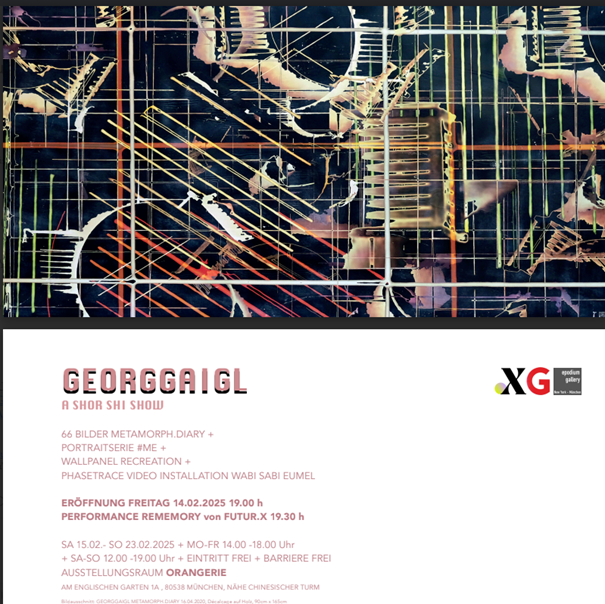
Erinnerung gleicht einem Schock. Memory is like a shock.
Die Erinnerung an einen bestimmten Tag speist sich oft durch ein besonderes Ereignis, das verbunden ist mit Bildern aus Zeitungen, Nachrichtensendungen oder Online-News. Die angestoßene Erinnerung befreit Assoziationen und setzt sie zum individuellen Leben in Beziehung.Jedoch bleibt der Rückblick nicht wie eine Momentum stehen, sondern vollzieht sich als einzigartiger Prozess im Einfluss von emotionalen Erfahrungen und prägenden Erlebnissen. Die Erinnerung befindet sich stets im Fluss. Das Bild davon ist gleichsam eine oszillierend schillernde Oberfläche, die sich fortwährend ändert, unscharf wird und im nächsten Moment sich wieder aufklärt und Augenblicke der Wahrheit preis gibt.
Täglich erfolgt zu einem Newsclip eine bildliche Transformation.
Eine filmischen Information, zum Beispiel ein Newsclip, wird zu einem statischen Bild transformiert.
Durch digitale Bearbeitung und Manipulation entsteht eine Umdeutung und Verschleierung der Filmquelle. Diese kann aber über den zu jedem Bild beigefügten verlinkten QR-Code eingesehen werden.Dadurch kann beim Betrachten des Bildes ein gewonnenes ästhetisches Empfinden beträchtlich gestört und verwirrt werden, sobald der Inhalt des Videos bekannt wird.
Ebenso ermöglicht es auch einen positiven Schock, der eine besondere, vielleicht persönliche Beziehung zu dem Bild entstehen lässt.
2018 Annual Exhibition of the Academy of Fine Arts Saturday 14.07.2018 from 14h – 21h. and 15.07.2018 – 22.07.2018 14 – 21h daily
The memorial plaque in the western staircase of the foyer of the Munich Academy of Fine Arts is not what it seems to be. The artist Paul Valentin has made a replica of it and has pulled it over the original like a second skin – what’s unseen is that he had changed the original lettering like an anagram into these new words:
„COULD THEY READ IN THE SECRECY OF THE SIGNS
AND OVERCOME THE FENCES OF THEIR GARDENS
BUT THEY DON’T SEE IT
AND SO THERE INNERMOST CHRONIST MAKES A MISTAKE“
Despite its prominent place, the historical plaque, which is established 1889, is not remembered by many students or annual visitors. Especially during the summer exhibition at the academy, it is, like many other artistic positions, easily overseen in the flood of presented works. The modest sculpture plays precisely with this problem of lacking attention.
The concept „Fals-Memory“ is the turning point of the work – It describes that incorrectly stored memories (such as the false encounter of Bugs Bunny at Disneyland) can hardly be erased from ones memory, even if one anknowledges that it never happened. It may also happen that the original text of the historical plaque is permanently overwritten in the collective memory of the visitors – Both physically during the annual exhibition, as well as mentally in the memory. The Replica takes the place of the original and „covers“ it in the truest sense. According to this verdict of cognitive research, Paul Valentin therefore stages his plaque as a memorial for attention – it should be a reminder that the great works of art, the changing experiences, which resonate with us inconspicuously, pass unseen without our attention.
(oxidizing process on the replica foto: Peter Pfitzner)
Findings detail the supply side of the digital sales equation, point toward hybrid models
by SARAH P. HANSON | 29 June 2017
The Art Newspaper
The size of the online market depends on the definition and price range of artworks, Tefaf's addendum report finds
The European Fine Art Fair (TEFAF) in Maastricht today (29 June) released its Art Market Report: Online Focus, a supplement to the annual Art Market Report released in March.
Her findings mostly confirm the most noticeable trends, namely that large auctioneers who have embraced their digital platforms—Heritage, Christie’s, and Sotheby’s—claim the largest share of an estimated $3.1b market (which the Hiscox Online Art Sales Report puts it at $3.75b; Art Basel’s The Art Market 2017 report, $4.9b). Pownall’s report further qualifies that of the $3.1b, fine art and antiques account for only $2.6b (the rest being other collectibles, automobiles, wine, etc).
The data is derived from “profiles of 100 companies”, 39 of which responded to a survey; a survey of more than 8,000 dealers, with a response rate of 8%; and a sample of data from 3,349 auction houses who list on Tefaf partner Invaluable. In her surveys, Pownall defined art as “objects including fine art, antiques, decorative art, collectibles, haute jewellery, photography, and design”, but the queried companies include e-tailers like Etsy and RubyLane alongside art-specific businesses.
Dealers are rethinking the bricks-and-mortar model in favour of temporary, collaborative and virtual platforms by ANNY SHAW | 13 July 2017
The Art Newspaper
For dealer Anthony Reynolds, the turning point came when the lease on his London gallery ran out and his landlord announced he was tripling the rent. “I thought to myself, I can either find another space or I can find a different way to do this,” the gallerist says.
Reynolds chose the alternative route and, after 32 years in three successive premises, closed his permanent venue in 2015. “Essentially I abandoned the tyranny of the single space,” he explains. “You have to keep funding it and filling it, and artists have to think about how to use it. What was more interesting was to think about operating a gallery as normal, but without a fixed space.”
Representing the same 20 artists as he did before he closed, for the past two years Reynolds has been staging exhibitions in other commercial galleries, including London’s Annely Juda Fine Art, Independent Régence in Brussels, and Àngels in Barcelona. There are further plans to show in Tehran and Tokyo. The aim is to develop “collaboration between galleries rather than an alternative to galleries”, Reynolds says, noting that costs and proceeds are usually split down the middle with the hosting gallery.